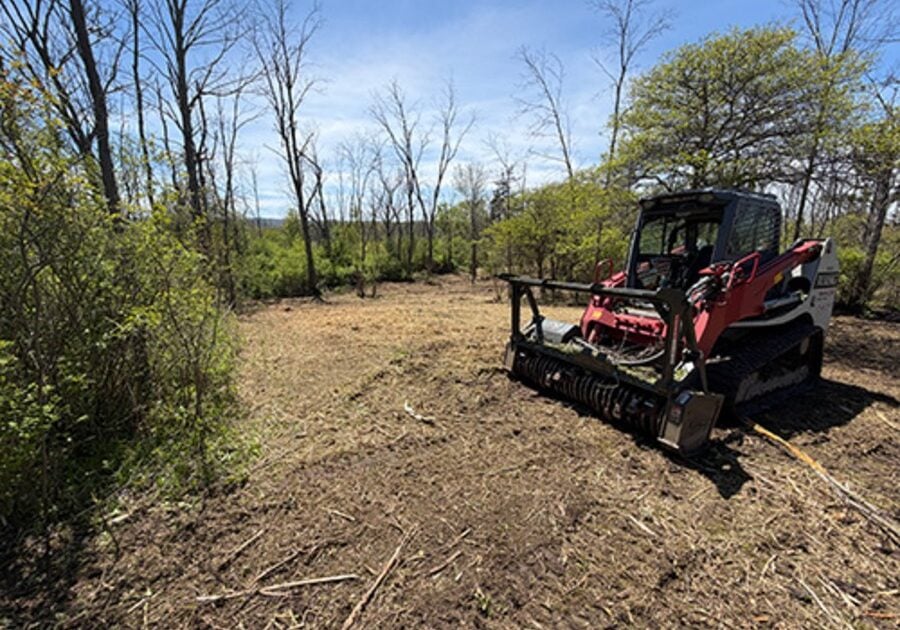
A habitat restoration project is underway at the Honeoye Creek Wildlife Management Area in Ontario County, where the New York State Chapter of the National Wild Turkey Federation (NWTF) and the Department of Environmental Conservation (DEC) are working to create healthier forest habitat for wild turkeys and other wildlife.
The New York NWTF State Chapter has committed $18,700 through its Super Fund program to support the project, which includes forestry mulching on a 9.5-acre section of the wildlife management area in the Town of Richmond, followed by herbicide treatments to control invasive plant species. Funding will also support follow-up herbicide treatment on a previously restored 13.5-acre site.
The 9.5-acre tract is currently dominated by invasive shrubs that suppress the growth of native vegetation and reduce the area’s value as wildlife habitat. Before work began, DEC biologists marked desirable young trees to preserve during the mulching process.
Officials said removing invasive species will allow native shrubs and young trees to flourish, creating a healthier young forest that provides food, shelter, and nesting habitat for wildlife.
The adjacent 13.5-acre site has already undergone similar restoration work. DEC said that area, once filled with invasive shrubs and dead ash trees, is now seeing the return of native vegetation, with only limited invasive species remaining for follow-up treatment.
“The Honeoye Creek project is a great example of how improving forest health improves wild turkey habitat,” said Mitch Blake, NWTF district biologist. “By forestry mowing the understory in these units, we are creating great brood-rearing habitat for wild turkeys that is critical for ensuring recruitment into the population. Treating the invasive species not only improves forest health, but allows a diversity of native vegetation to flourish, which will attract a host of insects that will most definitely help grow wild turkey poults.”
Because the new restoration area is adjacent to previously improved habitat already being used by nesting hens, biologists expect the project to provide immediate benefits for local wild turkey populations. Numerous other game and non-game wildlife species are also expected to benefit from the increased native vegetation and insect populations.
DEC Wildlife Biologist Jessica Haggerty said partnerships like the one with NWTF allow the agency to complete larger habitat improvement projects more efficiently.
“NWTF partnerships are a pivotal source of funding that allows the New York State Department of Environmental Conservation to focus on habitat improvement planning and work,” Haggerty said. “The habitat improvement efforts on Honeoye Creek Wildlife Management Area will transform a dense wooded area choked by aggressive invasive species into productive wildlife habitat that will improve the quality of life for turkeys and the variety of game and non-game species on site.”
Haggerty added that the restored habitat will provide additional food and cover for wildlife while improving hunting and wildlife viewing opportunities at the popular public property.
The NWTF Super Fund program, established in 1985, pools money raised by local chapters to support wild turkey restoration, habitat management, and other conservation projects across the country.