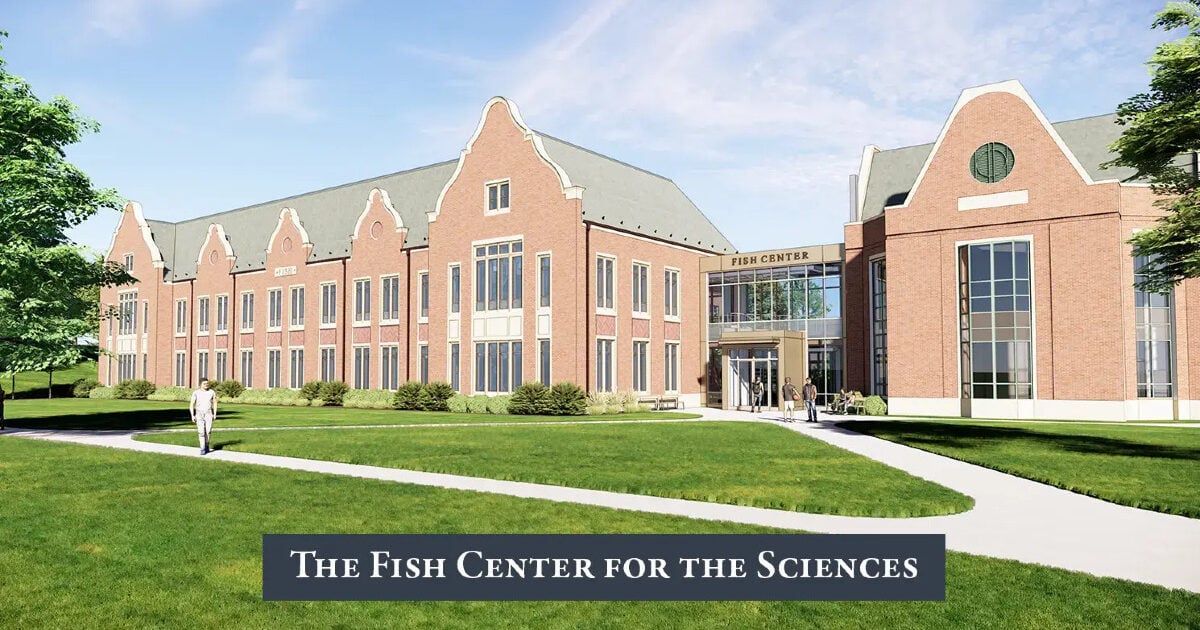
Hobart and William Smith has secured another major state investment for its new Fish Center for the Sciences, receiving a $3 million Higher Education Capital Matching Grant Program (HECap) award to help advance the transformative campus project.
The grant, awarded through the Dormitory Authority of the State of New York (DASNY), will fund advanced laboratory equipment, scientific instrumentation, classroom technology and specialized learning spaces. It will also help pay for the construction of a greenhouse and vivarium, along with infrastructure improvements, including HVAC upgrades, landscaping, and site restoration.
The award builds on a $5 million HECap grant the college received in 2025, bringing the state’s total investment in the project to $8 million.
The new 40,000-square-foot Fish Center for the Sciences, along with renovations to Lansing, Rosenberg and Gulick halls, is the centerpiece of Hobart and William Smith’s $400 million Further Together comprehensive campaign. The project is expected to be completed in the fall of 2027.
“This investment by New York State is an investment in our students, our region and the future of scientific discovery,” President Mark D. Gearan said. “We are deeply grateful to Governor Kathy Hochul, our state legislative delegation and DASNY for their confidence in Hobart and William Smith and their partnership in this transformative project.”
Gearan said the project will strengthen the college’s ability to educate future scientists, expand research opportunities and support the long-term economic vitality of Geneva and the Finger Lakes region.
More than 40 percent of Hobart and William Smith students major or minor in a science discipline, and all students complete at least one science course as part of the liberal arts curriculum.
College officials say the new and renovated facilities will enhance programs in biology, chemistry, physics, geoscience and psychological science while creating new opportunities in fields such as public health, environmental science, aquatic studies and data analytics. The project is also expected to position the college for future graduate-level science programs.
Hobart and William Smith is recognized nationally for undergraduate research and is designated as a Carnegie Research College. Faculty regularly receive grants from organizations including the National Science Foundation and the National Institutes of Health, while the college’s Finger Lakes Institute continues to serve as a regional leader in environmental research and education.
The college also highlighted the project’s economic impact. According to the Center for Governmental Research, Hobart and William Smith contributes an estimated $220 million annually to the Geneva and Finger Lakes economy. Construction of the Fish Center is employing contractors and subcontractors from across New York, and officials say the completed facility will help attract more students, faculty and research opportunities to the region.
To date, Hobart and William Smith has raised more than $42 million toward the Fish Center project, including a $25 million lead gift from alumna and Honorary Trustee Cynthia Gelsthorpe Fish ’82 and John F. Fish, for whom the center is named.