Paul Szmal: Wildlife rock stars are in the house with us and as always they have brought a guest. So who do I have here? Go ahead and introduce yourself James.
Guest: I'm Steve.
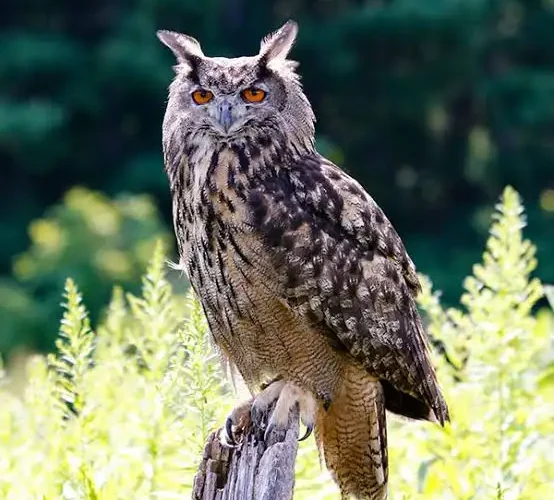
Paul Szmal: All right, James and Steve are accompanied by Ozzy. Ozzy is no, not the rock and roll singer who is unfortunately no longer with us. But this is Ozzy the eagle owl.
Guest: Yes, so this is Ozzy the Eurasian eagle owl, he is one of the largest owl species. He's about top three in wingspan height and weight. But he is a very large owl. But he only weighs about five pounds only five.
Paul Szmal: Yep, hollow bones and just a lot of feathers.
Guest: Yeah, well the plumage is pretty serious going on with him. How thick are those feathers?
Paul Szmal: Um, they're not very thick they just have a lot of surface area. So there's they're spread out and so it just makes him look a lot larger than he actually is. So if he were to stand up tall like when you see his legs they just look very skinny in comparison to the rest of his body. He's very calm.
Guest: He is, he's he's very good. Once he's up on your arm and perched up and feels comfortable now I have to point out that he is tethered to your arm because he is capable of full flight.
Paul Szmal: Yes, Ozzy is fully flighted and he also has some very sharp talons that can reach a couple centimeters. While also having 600 pounds of pressure in his tail as a matter of fact now. He just tried to fly and was flapping away. I don't know if you were able to hear that and James is trying to get him situated here. So so that's actually a really well-known behavior in Raptor communities, it's called baiting.
Guest: Yeah, and so oftentimes if they get some type of stimulus or something that catches their attention they may try to fly off the glove, which is what the jesses and tethers are for, right? So he's completely fine. He just is trying to go look at something that he caught his attention.
Paul Szmal: Yeah, why I don't blame him for being curious being in a foreign environment. Sure. You want to check everything out? So how old is he?
Guest: I believe Ozzy is now seven years old.
Paul Szmal: Ah, what's his life expectancy?
Guest: They can live over 40 years.
Paul Szmal: Wow. Okay, so he's he's early gone in life and yeah, he's still relatively young. Yeah. Yeah, and what the owls eat?
Guest: Real well, this species can really eat almost anything. Oftentimes they'll go after other owls. But their typical prey is usually small mammals some snakes rodents. Ozzy's favorite thing to eat is quail.
Paul Szmal: Really?
Guest: Yeah, so if you see those big talons down there on James's arm, yeah, that's his main hunting weapon. Actually, not his beak. He'll fly down and grab an animal with over 700 pounds of pressure.
Paul Szmal: Yeah. Yeah, I I would not want to get grabbed by those that would definitely hurt because his uh, his claws. Not only are they massively curved, they're about I think if you were gonna straighten them out they'd be at least an inch long and I've got to imagine that the points are pretty sharp.
Guest: Yeah, he can easily break skin.
Paul Szmal: Wildlife rock stars with us here on FLX morning. Finger Lakes news radio. So I've got to think that Ozzy is a big hit when you guys go out and do presentations kids got to love him.
Guest: Absolutely. Yeah, many people don't get to be face-to-face with an owl very often. So he is very striking when people first see him because of his size his beautiful orange eyes. And as you mentioned his plumage is just gorgeous and he's got a small little snout type beak.
Paul Szmal: Mm-hmm, and he uses that as well when he has his prey to try to rip flesh off. But being an owl oftentimes if it's a small enough animal, they will just swallow it whole.
Guest: Oh my gosh. Wow, so you you go to town sometimes don't you Ozzy? He does.
Paul Szmal: So when when Ozzy is not doing presentations, what's his habitat here?
Guest: So he has it's pretty much called a muse for raptors. So it's a large enclosed area with kind of gating and net around the outside. So he has the ability to fly within there. Well, it's not great distances. He has a very pretty large enclosure. Like it's not like a birdcage people would think it's a full outdoor enclosure that he can actually achieve flight in.
Paul Szmal: And I would imagine that's pretty important that he's able to fly and get that exercise because otherwise because otherwise the muscles would atrophy, right?
Guest: Yeah, being able to have some free flight as well as variations of purchase for him to go on whether that be different textures different widths and at different heights off the ground.
Paul Szmal: Now if we were gonna go visit his natural habitat where would we wind up going?
Guest: He's all over Europe and Asia. So Europe Asia and northern Africa is pretty much where their habitat.
Paul Szmal: How do we come about acquiring Ozzy?
Guest: So Ozzy actually was born at another wildlife facility near Buffalo called Hawk Creek. And then Ozzy came to us as a donation from them to be used as an educational ambassador.
Paul Szmal: Yeah, now how long has he been on board?
Guest: He's since he was an outlet. So since he was just a little puffball of feathers. He's been with the wildlife rock stars.
Paul Szmal: Yeah, when he was in when he was an outlet how big was he in comparison to what he is now?
Guest: Oh my god. Yeah, yeah.
Paul Szmal: And and now he's the size of several softballs. Yes, because I'm gonna guess like standing on your on your arm I'm gonna measure him up to be what close to a close to a foot over a foot over a foot. Almost two feet when he stands up. Yeah. Yeah, they have about a six-foot wingspan and and his tail which is all feathers, but it's it's a symmetrical tail. It's wide and it's long.
Guest: Mm-hmm. Steve our James is just blowing a little air at him to get his attention.
Paul Szmal: Yes, Ozzy can be very distracted whether it's different light glares or shiny things or windows. So yeah as Steve was mentioning with baiting once they kind of focus in on something trying to distract them from that.
Guest: Yeah. It was funny. I was trying to take a picture of him outside the studio before we came on the air and all he wanted to do was turn his head and look down the hallway. He is very photogenic, but sometimes he gets shy.
Paul Szmal: Yeah. Well, he's doing he's doing good here today. So he's used to being in in the indoor environment like this for presentations or yes. Yes. He does not do many outdoor presentations just because we wouldn't want the off chance of him to somehow escape and then maybe cause harm to himself.
Guest: Yeah, yes, does he have the the muscular strength to be able to snap that tether or?
Paul Szmal: Not generally if anything, he would have to like it would be a material failure. So like an unexpected material failure. So I don't like him flying wouldn't produce enough like lift.
Guest: Okay, snap the strap. Like maybe if he were to like grab it with his beak and have an ability to anchor and something he could like rip it with cutting. Yeah, but in general this is a very thick leather strap that he's just not gonna produce enough lift by flapping to be able to break.
Paul Szmal: Now the handlers glove that you're wearing with this tether. I've never had a chance to ask about one of these before. What kind of is that a leather material as well?
Guest: It is. Yep. So this is Falconer's glove as well.
Paul Szmal: Oh, okay. I knew there was a turn for it. I think of what it was not very easy for him to puncture which is safer for my arm.
Guest: Yeah, how is how thick is that?
Paul Szmal: I wouldn't say it's too thick.
Guest: Mmm what has to be with those claws. So when is he gonna be part of the wildlife Wednesdays?
Paul Szmal: He might be he might make an appearance at one. But he will be attending some of our other presentations coming up. Yeah. And I want to remind everybody if you search wildlife rock stars on the web that you can find out about presentations. Everything from school presentations to birthday parties and events as you guys especially in the summertime. This is your busy time of year. You're out and about like quite a few times a week.
Guest: Yeah, absolutely. And actually tomorrow we will be at the Finger Lakes Reptile Expo in Auburn. And then coming up next Tuesday, we'll be attending FLCC's Envirothon. So a lot of exciting events coming up for us this year. So who's going to the reptile Expo? Animal wise so that will be staff wise me and Santino for the wildlife rock stars. But we'll be bringing a bunch of different representative reptiles. So we have an alligator snapping turtle named Bubba who might make an appearance. Okay, a couple snakes and some with some big guy lizards a couple tegus.
Paul Szmal: Oh, yeah. Okay. So we have the whole menagerie that's gonna be out on the road. So check out the wildlife rock stars on the web to find out more and Ozzie. Appreciate you making an appearance here this morning. He's generally indifferent to me saying thank you.
Guest: That's fine guys, thank you for bringing him in man, he is gorgeous.
Paul Szmal: Thank you, amazing animal.