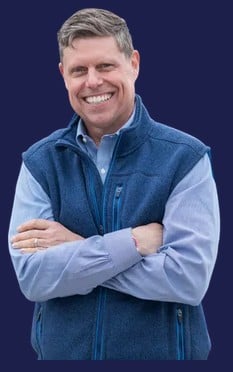
Ted Baker: Good morning, it's FLX Morning Monday, and no, I'm not Paul, I'm the old guy, Ted Baker. Paul has a day off, it's 7.50, and we're going right to guest-o-rama today. We have Michael Mills with us in the studio, running for state senate in the 54th district. Good morning.
Michael Mills: Good morning. Thanks for having me on. It's been a while since we talked.
Ted Baker: Yes, it has. So let me get the dumb horse race question out of the way, right off the top. How does a democrat get elected in a senate district that the republicans have had forever and won two-thirds of the vote last time?
Michael Mills: Yeah, it's an important question, and I think the biggest thing people need to understand is that it's a slightly leaning republican district. Democrats have just underperformed. Only 39% of the electorate is registered republican. So it is a fair game, and so democrats need to talk about issues that matter to people. We need to talk about affordability. We need to talk about protecting our lakes and our environment, and not being the waste dump and the electric plug for the rest of the state. And we need to talk about fighting our farmers, and we've been doing that, and we've been getting great response across the district.
Ted Baker: Let's talk a little bit about your background. Our listeners probably know you from the Geneva Bid, the Ontario County Chamber of Commerce, Canandaigua City Council. They might not know about your time in the southeast, in the Atlanta area, before you came back to the Finger Lakes, where you had a very wide experience in agency work and lobbying and all kinds of different things.
Michael Mills: Yeah. So I grew up in Rochester, but then went to Hobart College, but then went to graduate school in Atlanta. And I stayed for a number of years after, and my wife brought us back. She's actually a professor at Hobart, William Smith. And so while I was there, my work was in public policy. I ran a group called the Southeast Energy Efficiency Alliance, which was trying to build an energy efficiency marketplace across 11 states in the southeast. I worked on water legislation. We passed the first water planning district in the state of Georgia. It was a city that was being fined a million dollars a day by the federal government for failing to meet water quality standards. And so we created a planning district to change that. So yeah. So I've spent nearly 30 years of my career focused on public policy, passing legislation at the state, local, and federal level, including over the last couple of years, led an international trade delegation to Ireland and the UK to try and grow exchange of fintech and payments businesses and educational opportunities. So yeah, lots of policy experience throughout my career.
Ted Baker: The Democratic primary is coming up on June 23rd. Where do you feel that you differ and can improve upon what your opponent can offer?
Michael Mills: Yeah. I mean, I think there are two big pieces here. One is electoral success. I've been elected to Canada, I go to city council, but I've also gotten people elected. I was the chair of the Pittsburgh Democratic Committee when we got the first Democrats in the history, you know, nearly 200 year history of Pittsburgh elected. So electability matters. And the second is that policy experience. You know, it's easy to have bumper sticker slogans and to say what you would do, but I've actually passed legislation. I've actually built coalitions to tackle tough issues, whether it was protecting rural hospitals, working on dropout prevention for youth. So I've been in the game. I know how it works. It's not just enough to get a seat at the table in Albany, which we do not have. You have to do something with it when you get there.
Ted Baker: I've always wondered about that. Why the voters would elect Republicans when Republicans can't get anything done in Albany because it's all Democratic in Albany?
Michael Mills: Yeah. We have to give people credit for starting with their shared experience, their lived experience. And we live in a district that has a lot of traditionally conservative folks and Democrats have not appealed to them. We've, we've over certainly over recent years, you know, we've stopped focusing on those core kitchen table issues that matter to people, which is exclusively what I focused on my career is, you know, during COVID getting people downtown businesses with the bid back opened and people going there safely with the Ontario County Chamber of Commerce, making sure that a city of Canandaigua got a downtown revitalization, $10 million grant. Right. So we've got to get back to kitchen table issues. And I think that's, what's been missing.
Ted Baker: Affordability. That's the big one that everyone's talking about. Gas prices, maybe they'll go down with this agreement, but do we've had an agreement every couple of days now for the last month. So how can you work in Albany to make life and basics more affordable for people in the Finger Lakes?
Michael Mills: Yeah. Let me give you an example with farms. So farms are the fiber of our local communities in this district. And they're under great strain for lots of reasons from tariffs to staffing, all sorts of things. But there's just bureaucracy after bureaucracy. So one of the things I want to do is anytime a new regulation comes in that impacts farms, I want to make sure that we are reviewing what the impact of the paperwork of the new rule will have on small and medium income farms. Speaking of farms, again, one of the things I want to focus on is they're having real challenges transferring those entities to the next generation. And so I want to make sure that we are getting a tax credit for the money that they might spend with planning, bringing in accountants and other people to help them plan for that transition. So there's a lot we can do there. Also, you know, looking at health care. New York State has tried for years to pass the New York Health Act, which would basically create universal health care in New York State. It's one of the biggest drivers of affordability, and I'm for it. We've got to get that over the finish line.
Ted Baker: The campaign website is electmills.com, and I know you have an event coming up on Wednesday night. And tell us about this. You call your volunteers campaign volunteers.
Michael Mills: Yeah. So that's an event from the start of this. And it's really the work I've done my whole career. But we see this as a community. It's not about me. It's not about winning an election. It really is about the people that we're trying to help. And so my wife and I invite people to our house and we get together. We've been doing it for a couple of years just for other candidates, but doing it for ourselves now. We have great Finger Lakes wine and food and we write postcards and we've been writing postcards for other candidates in the 2025 election. And it's just a chance to say we are people in this community who care about this place and we believe in this guy. And we're going to put our pen to paper literally and get the word out. So that'll be on Wednesday night from six to eight.
Ted Baker: And you've said as you tour around the district, one of the things that's coming up a lot are these big data centers. I mean, we've had the discussion of the power plant down on Seneca Lake for years and years and years. And now there are more talk about putting these things in and taking up giant gobs of electricity.
Michael Mills: Yeah. So you touched on something that I don't want us to gloss over. The Greenidge power plant on Seneca Lake is a crypto mine predominantly. And the governor, in her wisdom, has decided that we should permit that. And I'm the only one, Republican or Democrat, in this region who has stood up to her. I wrote a Finger Lakes Times op-ed saying that that is unconscionable. And I still believe that. But data centers, and we're talking about these hyperscale things, right? It's not the data center hospital needs or local business. And so that's a difference with my opponent and I. He, in a debate recently, said, well, they're coming. And so we need to work with developers to make sure that they're the least impactful that they can be. And I disagree with that. They're only coming if we let them. And the legislature this year passed a one-year moratorium. And I don't think it goes far enough. Data centers provide tax into the community. They bring a lot of tax revenue into the community, which is the point. They are a problem, so they pay for the problem. But they use tons of energy. They use tons of water. And so I don't want a moratorium. I want them to not happen in our state. But if they're going to happen, we need to follow the Oregon model, which says you can come, but you need to be run by renewable energy and you need to pay for it. We shouldn't, as taxpayers and residents, see our energy prices spike because they want to open a data center.
Ted Baker: I wish we had more time today. We're getting towards the end of our segment, so it's time for the bumper sticker. Vote for Michael Mills for Senate because?
Michael Mills: Because we need a seat at the table. I'm the guy who can get us one, and I know what to do when we get there.
Ted Baker: All right. The primary election is on June 23rd, and of course, the general in November. It's good to see you again. And I learned something new today. I did not know that you were a Hobart hockey goalie.
Michael Mills: Yes, that was one of the greatest experiences growing up. Not the team that they have today. It was a much more rough-and-tumble league, and we weren't as good, but I'm a proud skatesman.
Ted Baker: All right. Thanks for your time.
Michael Mills: Appreciate it.
Ted Baker: Michael Mills for State Senate. It's electmills.com. That is the campaign website, and we are coming up now to 7.58. It's AFL-X Morning Monday.