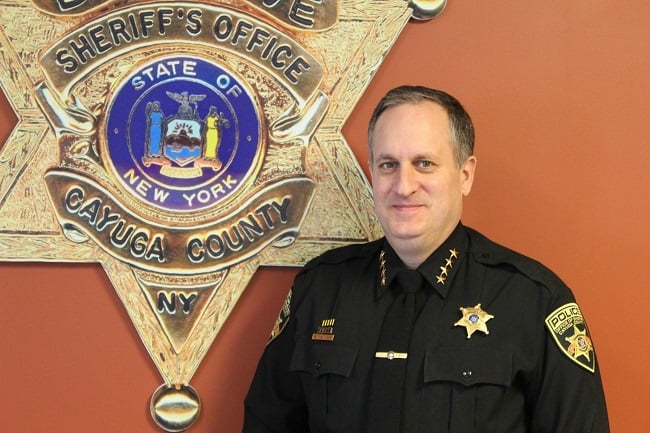
Paul Szmal: It is Lawman Thursday. I'm going to subtitle it though, A Tale of Two Bryans. First off, we have Cayuga County Sheriff Brian Skank joining us. Pleasure as always. Brian, how are you?
Guest: Morning, Paul, and good morning to everybody listening today.
Paul Szmal: And we also have a peer support advocate from Liberty Resources. That's Brian Bush that is joining us as well. Brian, number two, how are you?
Guest: I'm doing well, Paul. Thank you. And it's Brian with a Y. I like to be unique.
Paul Szmal: Yeah, there you go. There you go. Brian with a Y. Let's start with you by talking about what exactly a peer support advocate is.
Guest: Absolutely. So a peer specialist or a peer advocate is someone that identifies as being in a program of recovery, maybe from substance use disorder, alcohol use disorder, post-traumatic stress, trauma, mental or behavioral health. And being at a manageable position in our own recovery, we are certified to then help empower and support others that might be beginning their recovery foundation or beginning their journeys to help connect or bridge gaps in care or services. So a peer support advocate is drawing on personal experience to help assist in the recovery process with others.
Paul Szmal: Absolutely, yes. Tell me a little bit about your experience and how you came to be in this position. How much time do we have?
Guest: In a nutshell, Paul, I was raised as an only child in a very stable family dynamic. My parents are still together. But as soon as I kind of like stepped outside that home security, I had an immense fear of the world, was bullied and sexually assaulted at a very young age. So I turned to substances in sixth and seventh grade to selectively numb out that fear and those anxieties. And unlike some of my friends at the time, I just could not stop when others, you know, were able to manage the use. And that followed me for 10 or 15 years and made my life completely unmanageable. In and out of Monroe County jail, you know, unemployable, went through multiple relationships, harmed a lot of people, including myself in the process. And eventually I hit a wall where, you know, the pain and suffering had become too much and decided I want to make a change. So a little over 10 years ago on that change and following the directions and suggestions of others led me to Kiewit County. And I haven't looked back since. And, you know, two years into my own sobriety, which is abstinence based, I met individuals like, you know, Sheriff Skank and Joel Campanola and multiple providers like Chad and Unity House that supported me. And I was sponsored to become a peer advocate. And like many of my other colleagues and peers out there, we're just looking to carry some message of hope or belief that we all can recover to the individuals that are still suffering. But to sum it up, and it's actually a tattoo that I have, it says someday this pain will be useful. So I think that that is a good metaphor for the peer specialist position.
Paul Szmal: Yeah, I think those are very prophetic words. Thank you. And thank you for taking the time to, you know, carry a little bit of a message here this morning.
Guest: Yeah, absolutely.
Paul Szmal: It is amazing to me that people that are in your position that are ongoing in their recovery can find the courage and the ability to use their previous experience to help others along that same path. That's not an easy thing to do.
Guest: It's not. And I think it's a natural trajectory for people that, you know, have lost everything and are looking to rebuild. However, I think it's one of those double-edged swords or precipices where if I'm being authentic and honest, you know, it's a really individualized position because the person has to be in a really healthy spot for their own recovery in order to help the next individual. We can't have the blind leading the blind out there. And as professionals, we have to remember and have the self-awareness that we, like ourselves in the past, are extremely mentally ill or vulnerable individuals. So, you know, a lot of ethics and self-awareness and self-care and work-life balance are pivotal to being a successful and ethical peer advocate.
Paul Szmal: I want to mention the Recovery Fest event that is going on in conjunction with the Auburn Alliance Church. That's going to be coming up this Saturday, starting at one o'clock. This event looks fantastic. There's entertainment and there's a bunch of other stuff. Tell us a little bit more about it.
Guest: So Saturday, June 13th from 1 to 9 at 630 North Seward at the Alliance Church. It's free to the public. It is being facilitated by a friend and colleague of mine, Jasmine Sanchez. And she had the inaugural one last year and it was an excellent turnout for the community as it comes from a faith-based foundation, but again, is open to anybody that identifies with mental health, domestic violence, post-traumatic stress, substance or alcohol use disorder, or people that just want to show up and feel connected as part of a healthier movement. And that event, again, is June 13th from 1 until 9. Admission is free. And again, that is at the Auburn Alliance Church. Auburnalliance.com slash CCRF will give you more information.
Paul Szmal: We're talking with Brian Bush, a peer support advocate and Cougar County Sheriff Brian Skank here on FLX Morning. Let's shift over to Sheriff Skank here. One of the things that never unfortunately goes away that your office continues to work on is investigations into welfare fraud.
Guest: Yes. Unfortunately, we're still seeing a growing number of cases involving fraud committed in our community for funds that should be going to people that are truly in need, but oftentimes are defrauded and going to people that shouldn't get those. But about a year ago, we formed a task force here at the Sheriff's Office with our District Attorney's Office and our Department of Social Services here in Cougar County to more aggressively investigate these types of crimes. We've had a lot of success with that. We've made a number of arrests over the past year, and I think today we're actually executing four, four warrants, arrest warrants relative to welfare fraud just today, but we've had some good success. We want people to know that, you know, it's not okay to defraud the government. These funds are put aside for people that really need help. We want to make sure that they go to the right place and we're going to continue to aggressively investigate these crimes.
Paul Szmal: Now there's a little bit of a sad note to pass along here and that you lost a retired four-legged member of the department.
Guest: We did. One of our canine partners, Aaron, unfortunately passed away here in May. Aaron served with us from 2014 to 2021 along with his partner, Lieutenant Sloan, so we were sorry to lose Aaron. When Aaron retired in 2021, he did go to stay with Lieutenant Sloan at his home for his retirement years, but we just want to recognize his service and, you know, it's unfortunate that he was lost and certainly part of our law enforcement family and part of Lieutenant Sloan's family.
Paul Szmal: That's fairly commonplace, right? For when a canine retires for them to be adopted, shall we say, by their handler?
Guest: It is. That is typical. I mean, they form such a tight bond. They're not just a tool or a resource. They really become part of your family and that was the case too with Aaron. But I know most agencies, that is the case. When they retire, they do stay with the handler, which is a great thing.
Paul Szmal: Related to animals, your office now has a local animal abuse registry that is up on the web.
Guest: We do. On our website, we do have the registry up. I know we've talked about this on your show in the past. We did implement, pass local law here in Cougar County to form the registry last year, and we do have it up and running. We currently have six offenders that are on the site. You can go on to our website and click on the registry tab and see those offenders and that information is there. So if somebody is adopting an animal out or somebody that's getting rid of a potential pet, they can go on and check and see if anybody on that registry is someone that's trying to adopt an animal from them. And the goal is to prevent abuse and keep these people from re-offending and abusing other animals.
Paul Szmal: Right. And also you're working on accreditation for the civil division. What is that accreditation and what does it mean to that division?
Guest: We are. So this would be the third division. If we can accomplish that this year, that would be accredited within our Sheriff's office. We've accredited our road patrol division and our jail division. We're now seeking to accredit our civil division and that would be an accreditation that is a voluntary program to the New York State Sheriff's Association. It would signify that we're meeting 121 specific standards covering personnel, management, fiscal operation, records management, and civil law enforcement. And to boil that down, it basically would indicate that we are following the most current best practices within that division and working under current sound, current and sound policies and procedures. And I'm hopeful that we can accomplish that goal by the end of the year. I have six months left in my term and I'll be done at the end of December, but I'm hoping this will be one of the last major initiatives that we'll accomplish and we'll have three of our three of our divisions accredited. I think we can make that happen.
Paul Szmal: As always, too, we'd like to mention any open houses or employment opportunities that are available.
Guest: We do. I appreciate that, Paul. Every Thursday here at the Sheriff's office, we're still holding open houses for anyone that wants to walk in and talk about career opportunities between two and 4 p.m. So any Thursday that would be today included between two and 4 p.m. Just anyone can stop by. And I know you're listening area goes beyond our Cuba County borders. I would encourage anyone throughout your listening area to look to the law and local law enforcement agencies in your community to see if there's any career opportunities. I know many agencies are recruiting and these are really, really great careers with great pay, great benefits and are very rewarding. I would highly encourage anyone listening to seek them out.
Paul Szmal: Brian with a Y, thank you for what you do. I know it is not easy sometimes. Continued success on your recovery.
Guest: Thank you, Paul.
Paul Szmal: And Sheriff Skank, we will check in with you next month.
Guest: Thank you, Paul. It's always a pleasure. We appreciate the opportunity.