


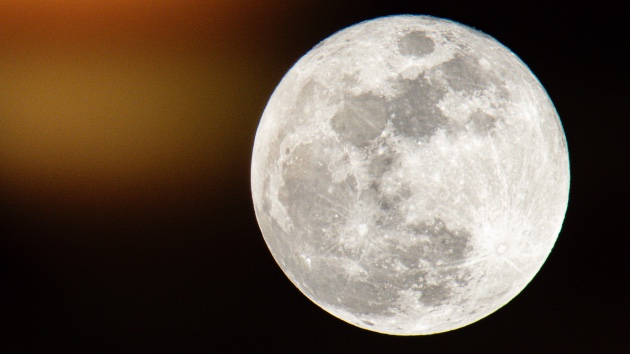
(NEW YORK) — It’s been 100 years since the 1st modern rocket launched. Humans are heading back to the moon
The experiment lasted only two and a half seconds, but it ignited a century of space exploration that sent humans to low Earth orbit and eventually to the moon.
On March 16, 1926, Robert H. Goddard launched the world’s first liquid-fueled rocket on a snowy farm in Massachusetts. Historians say that Goddard’s 10-foot rocket would pave the way for the modern machines that do everything from putting satellites in orbit to sending humans to the International Space Station and beyond.
“His unlocking of that ability to use liquid fuel really just sets the stage for any other country around the world that is launching rockets,” Ed Stewart, a curator at the U.S. Space & Rocket Center, told ABC News. “It all comes back down to March 16 in 1926 because he was the one that proved that it could be done and then actually did it.”
The rocket was the first of its kind, powered by liquid propellant rather than gunpowder or other solid fuels used by most rockets at the time, according to NASA. The rocket flew for less than three seconds and reached an altitude of about 41 feet.
While scientists overseas had already been experimenting with rocketry in places like Russia and Germany, according to historical documents, it was Goddard’s 1919 paper, “A Method of Reaching Extreme Altitudes,” that made the physicist’s discovery famous worldwide, explained Stewart.
“It caught the attention of people all around the world, even people that were doing some experimentation with rockets and liquid fuels and things like that in other parts of the world,” Stewart said.
The paper suggested that rockets could one day travel to the moon and caught the attention of the Smithsonian Institution, which invested money in rocket research.
“I think the breakthrough was, first of all, that Goddard had this dream of getting a rocket ship off the surface of the Earth,” said Charles “Chuck” Agosta, a physics professor at Goddard’s alma mater, Clark University. “And then, of course, the dream was to go to Mars.”
Other scientists, like Hermann Oberth of Germany, later built on Goddard’s theory, and that progress eventually contributed to the development of the V-2 rocket, Stewart noted. And eventually, rockets based on Goddard’s pioneering work led to sending astronauts into space and to the moon.
Goddard earned his master’s and doctorate in physics at Clark University in Worcester, Massachusetts, before returning to teach at the school in 1914. He eventually served as director of the physics department for two decades.
Today, faculty at Clark say his legacy still looms large on campus.
Goddard once used a bicycle wheel to show funding agencies how gyroscopes could help steer rockets in space. Today, Agosta uses that same wheel to teach his students about angular momentum.
Despite his legacy, Goddard’s breakthrough didn’t immediately capture the public’s imagination. Stewart says that when the first liquid-fueled rocket launched, space travel was still widely viewed as science fiction by many.
“I do think that at the time it was still so far-fetched that even once he proved that the basic version of the technology would work, people still were thinking of it more as a novelty,” Stewart said.
Much of what we know about those early experiments comes from Goddard’s wife, Esther Christine Kisk Goddard, a photographer from Worcester, Mass. She documented many of the tests, leaving behind footage that offers a window into the creation of the world’s first modern rockets.
According to NASA, Goddard created and launched more than 35 rockets throughout his lifetime. It was because of his pioneering work in modern rocketry that, in May 1959, NASA renamed its first spaceflight complex to the “Goddard Space Flight Center.”
The center is home to missions such as the Hubble Space Telescope, the James Webb Space Telescope, and the Nancy Grace Roman Space Telescope, scheduled to launch as early as fall 2026.
The global return to the moon and beyond
During his initial launch tests, Goddard fueled his rocket with gasoline and liquid oxygen, according to the Roswell Museum in New Mexico, where the physicist spent part of his career. Today’s modern rockets no longer use gasoline, opting for other fuels such as liquid hydrogen, liquid methane and refined kerosene along with liquid oxygen, which acts as an oxidizer.
On the 100th anniversary of Goddard’s discovery, the United States is on the cusp of sending the first astronauts to the moon since 1972 as part of the Artemis II mission. The 10-day trip will send four astronauts around the far side of the moon in NASA’s Orion spacecraft, launched into orbit by the most powerful rocket ever to send people into space. A rocket that may never have come to fruition had Goddard not experimented on that faithful day in 1926.
What could the next 100 years of rocket technology bring?
“I’m pretty confident that in a hundred years, we’re going to be all over space,” Agosta said.
Considering the thousands of airplanes in our own skies every day, he says it’s “inevitable” and that we’ll “at least be in the planets close to us” by the next century.
Copyright © 2026, ABC Audio. All rights reserved.