


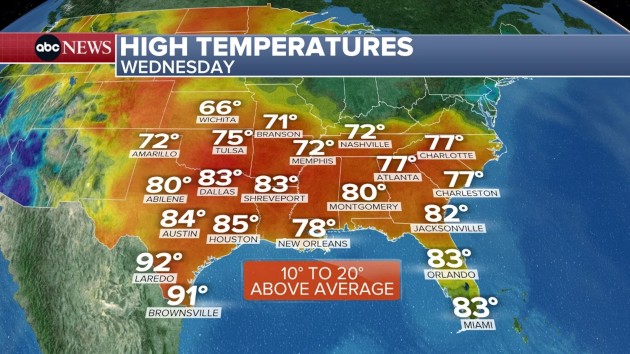
(NEW YORK) — Just a week before Thanksgiving, record-breaking heat is hitting parts of the South, with some cities setting daily records as temperatures rise 10 to 20 degrees above average.
Cities across Texas experienced record-high temperatures on Tuesday, with Waco reaching 87 degrees and Austin hitting 86 degrees. Dallas, which hit a high of 87 degrees on Tuesday, has not seen temperatures this warm this late into the year in 20 years.
Houston also shattered records on Tuesday, as it saw a temperature over 80 degrees for a record 245th day this year. The previous record of 243 days was set in 2012. This record could continue to grow, as Houston — which has only had 77 days of weather cooler than 80 degrees — will see temperatures in the low- to mid-80s for the rest of the week.
From Wednesday through Friday, record-high temperatures are possible from Houston to Charlotte, North Carolina, and areas farther south.
Other cities experiencing unseasonably warm weather include Jackson, Mississippi, which could see the temperature reach 81 degrees on Thursday, along with Atlanta, with highs consistently in the high 70s for the rest of the week.
This heat, which will move out of the South this weekend, will allow for a flood threat to develop from Texas to Missouri on Thursday.
While the heat lingers in the South, parts of the Southeast and Northeast will see temperatures “cooler than normal at times,” according to the National Weather Service.
The United States has been getting warmer every season since the early 1990s, according to the Environmental Protection Agency and the National Oceanic and Atmospheric Administration,.
This year, the El Niño-Southern Oscillation — a natural variation of warmer, neutral and cooler waters along the equatorial waters of the eastern Pacific — has been in the cooler pattern, or La Niña, since September and is expected to continue for much of winter.
This likely puts the U.S. in a dominant weather pattern for most of the winter, keeping the southern half of the country warmer and drier and the Pacific Northwest out to the Great Lakes cooler and wetter than average.
ABC News’ Kyle Reiman contributed to this report.
Copyright © 2025, ABC Audio. All rights reserved.