


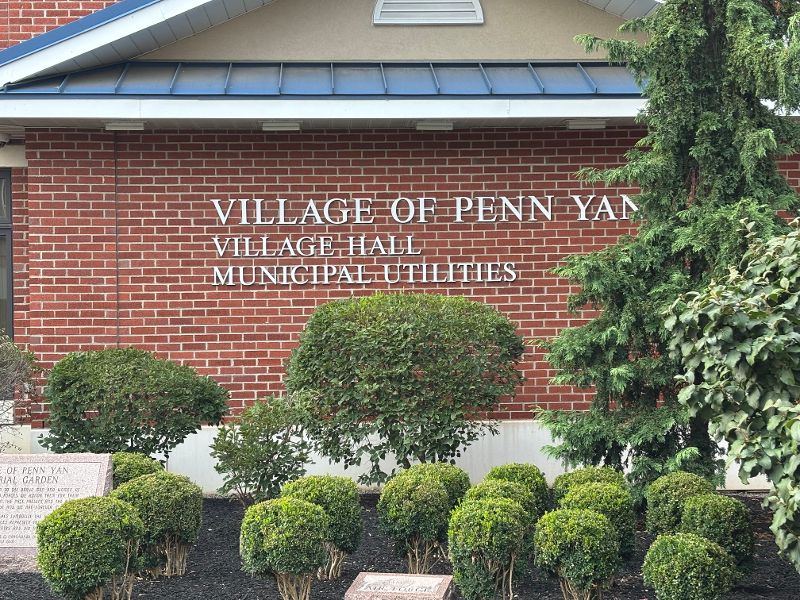
The Penn Yan Village Board formally accepted the resignation of Chief Water Treatment Plant Operator Matthew Fritz on Thursday.
The move follows a state audit released in July that found village officials failed to properly monitor and control overtime costs at the water treatment plant. Between June 2021 and November 2024, plant employees accrued $338,000 in overtime, making up as much as 32 percent of the $1.1 million in total wages during that time. Auditors reported that Fritz was responsible for nearly two-thirds of non-weekend overtime, totaling almost $90,000. The report also said the Department of Public Works leadership failed to approve overtime in advance, as required by the village’s employee handbook.
The state audit included six recommendations to curb excessive overtime and reduce pension-related costs. Village officials have agreed with the findings and say corrective measures are underway.
The village released this statement on Thursday:
The Village of Penn Yan owns and operates a Type IIA Water Treatment Plant (WTP) that provides drinking water to approximately 5,200 Village residents and 5,000 residents outside the Village. The WTP currently cannot operate without on-site staffing, requiring operators to man the facility 7 days a week, 365 days a year.
We appreciate the recent audit of our Water Treatment Plant, which provided valuable insight into our ongoing operations. This was a thorough review and our team has already taken steps to address the findings and build upon our operations. Due to fluctuating water production demands, ongoing capital projects, necessary ongoing facility improvements, evolving regulatory requirements, and weekend/holiday operational needs, overtime has increased. Below is a breakdown of the key factors:
-
Production demands: Water production at the plant varies throughout the year and year after year which impacts staffing needs and overtime. Production increased from 348 million Gallons Pumped in 2022 to 371 million Gallons Pumped in 2023.
-
Capital projects: Larger-scale projects have temporarily impacted the plant’s capacity and operational schedules, requiring additional operator hours. Recent capital projects include:
-
Filter rehabilitations
-
SCADA/PLC Upgrades
-
Replacement of raw water chlorine chemical feed lines
-
Replacement of four failed isolation valves in the Finished Water Pump Room
-
Mechanical and electrical upgrades to Filter Room air compressor system
-
-
Ongoing facility improvements: Constructed in 1998, the Water Treatment Plant has many components that are now obsolete, past their useful life, or no longer compliant with current regulations. Many improvements have been completed in house to save significantly on contracted costs, including:
-
Construction of five control cabinets with wiring and controls for chemical feed rooms
-
Upgraded control room with wiring and mounts for updated computers and camera systems
-
Repairs and improvements to Raw Water Building vacuum-prime system piping
-
Replacement of turbidimeters, chlorine meters, pH analyzers, and controllers used to monitor water quality
-
Addition of a day tank, wiring, and pump fill system in the bulk chlorine room
-
Replacement of Filter 1 and Filter 3 trough valves and actuators
-
-
Changing regulatory requirements and environmental impacts: Evolving regulatory requirements and changing of raw water quality (intake water from Keuka Lake) have led to operational changes, including slowing down production during warmer months to reduce filter flow rates to optimize treatment.
-
Unexpected water demands: Emergencies such as water main breaks, fires, or sudden spikes in usage from the Village or Wholesale Customers create unexpected demands, often resulting in extended plant operations.
The Village is committed to minimizing overtime where able to, including:
-
Split shift scheduling: In response to fluctuating production and water-quality-based process adjustments, a split shift schedule was implemented to better distribute weekday staffing.
-
Water Treatment Plant automation: The Village has long pursued full treatment plant automation. The cost has been unfeasible compared to the cost of full staffing during production. Due to this, the Village has applied for several funding opportunities. The Village has recently secured a grant to proceed with full automation of the plant per Department of Health’s requirements, with a project completion targeted for 2027.
Given the essential nature of the Water Treatment Plant and its current operational limitations, overtime remains a necessary component of maintaining safe and reliable drinking water. While strategic staffing adjustments have been made and future automation efforts are in progress to minimize overtime, current production demands, regulatory requirements, and infrastructure improvement efforts continue to require overtime staffing to ensure uninterrupted plant operations. We remain committed to transparency, ongoing improvements, and delivering safe and reliable water to all our customers.
Have all the Finger Lakes news from Finger Lakes News Radio delivered to your email every morning for FREE! Sign up by clicking here