

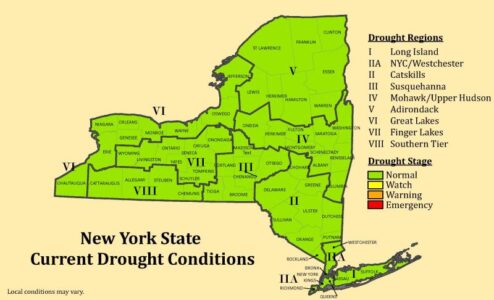
The statewide drought watch issued by the New York State Department of Environmental Conservation last fall was lifted on Friday.
In cooperation with the State’s Drought Management Task Force, DEC updated drought status from “Drought Watch” to “Normal” statewide, including New York City, after assessing recent precipitation and elevated levels of ground and surface water. While statewide and regional hydrological conditions have notably improved, localized dry conditions may persist and despite encouraging hydrological conditions, New Yorkers are urged to continue reducing unnecessary water use and waste, fixing leaks, and choosing efficient water fixtures.
New York State drought Region IIA, which includes New York City and Westchester County, is among the regions moving to normal status due to the satisfactory storage levels and refill probability of the New York City reservoirs.
“The lifting of the drought watch underscores the critical role of DEP’s strategic planning and adaptive management of New York City’s critical water resources,” said New York City Chief Climate Officer and DEP Commissioner Rohit T. Aggarwala. “I’m grateful to our fellow City agencies for their partnership and to all New Yorkers for their conservation efforts, which helped us save water. Let’s continue to use water wisely to ensure the resilience and reliability of the city’s water supply system.”
According to the New York City Department of Environmental Protection (DEP), the City’s reservoirs are at more than 75 percent capacity with over 420 billion gallons in storage. DEC continues to work closely with DEP to monitor reservoir conditions and encourage responsible water use, especially outdoors, regardless of the hydrological conditions or season.
New York State encourages ongoing water conservation to ensure adequate supply for all emergency uses. To protect water resources, homeowners are encouraged to voluntarily reduce water use and follow these tips:
- Reuse water collected in rain barrels, dehumidifiers or air conditioners to water plants.
- Use a broom, not a hose, to clean driveways and sidewalks.
- Fix leaking pipes, fixtures, toilets, hoses and faucets.
- Wash only full loads of dishes and laundry.
- Take shorter showers or fill the bathtub partly.
- Install water-saving plumbing fixtures.
- Don’t run the tap to make water hot or cold.
- Wash cars less frequently.
Have all the Finger Lakes news from Finger Lakes News Radio delivered to your email every morning for FREE! Sign up by clicking here